
Politics · Personal
Trump's Real Advantage Isn't Strength — It's Democratic Weakness
A viral post recently made the rounds on social media, crowing that Donald Trump "strategically dismantled the entire Democratic Party" over a decade, culminating in a UFC fighter mocking Michelle Obama. It is a perfect artifact of our moment: half trolling, half triumphalism, and wildly overstated. Yet behind the exaggeration is a serious critique Democrats would rather ignore — Trump has thrived not just because of his own political talents, but because the opposition has been too weak, too distracted, and too misaligned with the priorities of the average voter.
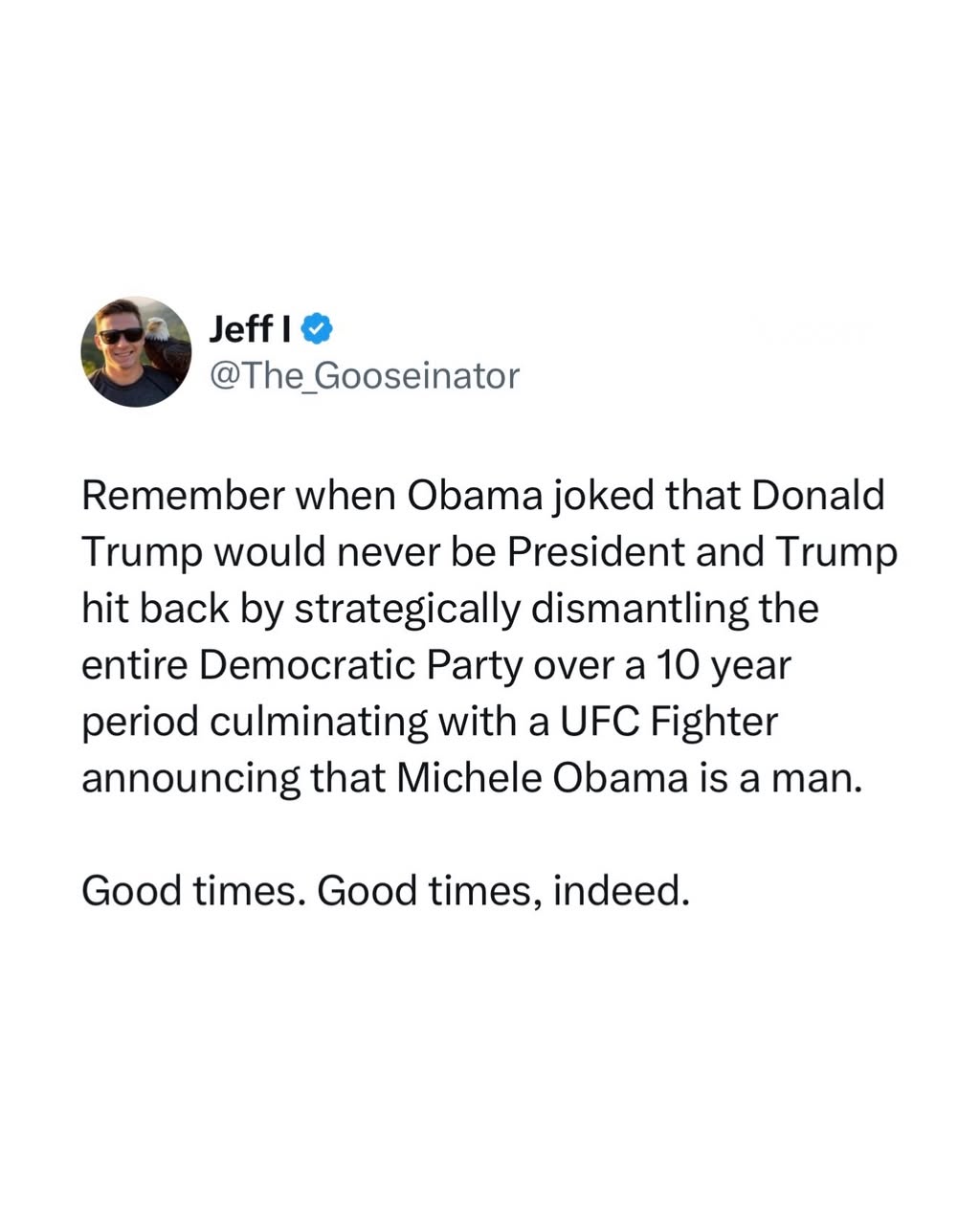
The punchline of the screenshot isn't literally true. The Democratic Party has not been "dismantled"; structurally, it remains competitive and in some ways advantaged heading into the 2026 midterms. But the spirit of the joke lands because it captures something real: at every key stage of Trump's rise, Democrats have failed to convert public frustration with him into a decisive, enduring advantage. That isn't a story about authoritarian destiny. It is a story about opposition malpractice.[[1]](https://www.nbcnews.com/politics/2026-election/poll-democrats-maintain-edge-fight-congress-trump-gets-poor-marks-rcna348913)[[2]](https://www.dataforprogress.org/blog/2026/5/21/democrats-lead-the-generic-ballot-by-8-points-as-midterms-approach)[[3]](https://eciks.org/8789-97836-trump-approval-second-term-low-nbc-poll)
📊 An Unpopular President In A Winnable Environment
Trump's power has always been as much a function of their weakness as of his own strength.
Start with the basic numbers. By any traditional measure, President Trump should be a drag on his party. A recent NBC News poll puts his approval at just 39% among all adults and 42% among registered voters — the lowest mark of his second term in that series — with 58% disapproving of his job performance. Historically, numbers like that spell midterm disaster.[[3]](https://eciks.org/8789-97836-trump-approval-second-term-low-nbc-poll)
Yet Republicans are not staring into an electoral abyss. In that same NBC survey, Democrats lead the generic congressional ballot by just 5 points — 49% of registered voters prefer Democratic control of Congress, while 44% prefer Republicans. Data for Progress, using a different methodology, finds Democrats with a somewhat larger 8‑point advantage, but that is still far from a realignment-level rout, especially given the structural tilt of the House map.[[2]](https://www.dataforprogress.org/blog/2026/5/21/democrats-lead-the-generic-ballot-by-8-points-as-midterms-approach)[[1]](https://www.nbcnews.com/politics/2026-election/poll-democrats-maintain-edge-fight-congress-trump-gets-poor-marks-rcna348913)
In other words: Trump is unpopular, but not fatal to his party. Democrats are competitive, but not dominant. That gap between what the environment should allow them to do and what they are actually doing is where the "Trump dismantled the Democrats" narrative gets its fuel.
🎯 The Opposition's Core Failure
One reason Trump keeps surviving storms that would sink a conventional politician is that he rarely faces a clear, disciplined alternative. Poll after poll shows that voters are most concerned about the economy, jobs, inflation, health care, and the basic cost of living. Data for Progress reports that when voters are asked who they trust more on key issues, Democrats have an edge on 12 of 15 topics tested, particularly on protecting Social Security and Medicare, lowering health care costs, and defending democracy.[[2]](https://www.dataforprogress.org/blog/2026/5/21/democrats-lead-the-generic-ballot-by-8-points-as-midterms-approach)
Those should be the foundation of a governing majority. Yet Democrats still struggle to keep the national conversation anchored in this terrain. Instead, too much of their energy gets spent chasing every cultural flashpoint, responding to every outrage, and litigating every social question at the level of moral absolutism rather than practical governance. The more they lean into a constant culture war, the more they play on Trump's preferred battlefield.
That's the malpractice: not that Democrats care about social issues — they obviously do and should — but that they have repeatedly allowed them to overshadow a more coherent, majoritarian message on economic and institutional stability.
⚔️ The Culture-War Trap
Republicans have made a strategic decision to emphasize a narrow cluster of high‑salience cultural fights: transgender participation in sports, gender‑affirming care for minors, and school‑related controversies like drag performances and curriculum battles. Whether one likes these priorities or not, GOP strategists have done their homework. The polling landscape is far more favorable to them here than on, say, Social Security cuts.
Gallup finds that 69% of Americans believe transgender athletes should compete on teams that match their birth sex, while only 26% say they should compete based on gender identity. The same survey reports that two‑thirds of adults think official documents like driver's licenses should list birth sex rather than gender identity. These are not fringe views; they are broad, cross‑partisan majorities.[[4]](https://news.gallup.com/poll/691454/two-thirds-prefer-birth-sex-ids-athletics.aspx)
That doesn't mean voters rank these issues above everything else. Even Gallup notes that most people still list economic concerns as their top priority. But when Democrats respond to these debates with maximalist rhetoric — painting any proposed restriction as bigotry, for example — they risk looking out of step with the median voter in the very communities they claim to defend.
From a purely strategic lens, this is a catastrophe. When your strongest terrain is economic security and institutional competence, voluntarily spending political capital defending the most unpopular edge of your cultural coalition is the opposite of message discipline. It hands Trump and his allies a weapon they can swing again and again, no matter how low his approval sinks.
🌫️ Trump Thrives In A Pessimistic Country
The other key piece of context is mood. The same NBC poll that records Trump's low approval also shows a deeply pessimistic country. A majority of Americans say the nation is on the wrong track, and sizable shares believe the United States' best days are behind it. That is the kind of environment in which a grievance‑driven populist can continue to command attention even when large majorities are tired of the show.[[1]](https://www.nbcnews.com/politics/2026-election/poll-democrats-maintain-edge-fight-congress-trump-gets-poor-marks-rcna348913)
Trump's core political talent is not policy stewardship; it is narrative dominance. He is extraordinarily good at keeping himself at the center of every argument, turning every news cycle into a referendum on him personally. When Democrats respond with a barrage of moral denunciations and symbolic fights, they feed that dynamic instead of breaking it.
The viral post about "dismantling" the Democratic Party captures this dynamic in miniature. It is less an empirical statement than an assertion of narrative control: the idea that history's arc is bending toward Trump because his enemies are doomed to lose. A confident, issues‑focused opposition would starve that narrative. A fractured, culturally consumed one reinforces it.
🏛️ What "Dismantling" Really Looks Like
Has Trump actually dismantled the Democratic Party? Not in any structural sense. Democrats still hold major urban centers, dominate younger age brackets, and in many states have the organizational muscle to win close races. Polling averages compiled by analysts like Nate Silver still show them favored, on paper, to win the national popular vote for the House.[[5]](https://www.natesilver.net/p/generic-ballot-average-2026-nate-silver-bulletin-congress-polls)
But there are quieter forms of decay that numbers don't capture as cleanly. When a party consistently underperforms the environment — losing winnable seats, failing to build durable margins in swing states, and repeatedly turning what should be referenda on the incumbent into referenda on its own cultural agenda — something more fundamental is breaking down.
Voters may dislike Trump's chaos but still decide, rationally, that they trust Republicans more on issues like border enforcement or are skeptical of the left's cultural priorities. When that happens, Trump doesn't need to be popular; he just needs the alternative to look worse.
🔀 The Choice Democrats Keep Making
The hard truth for Democrats is that they are not simply victims of Trump's authoritarian ambitions. They are also authors of their own weakness. They chose, again and again, to communicate in a way that flatters their most engaged activists rather than persuades conflicted voters. They chose to nationalize every local culture battle while allowing Republicans to localize economic frustrations onto Democratic incumbents. They chose symbolic fights over structural reforms that could have rebuilt trust in institutions.
Trump only reaches the Oval Office — and only retains such a powerful hold on the political imagination — when the opposition fails to offer a credible, compelling alternative. A president sitting at 39% approval in a country anxious about its future should be politically isolated. Instead, he is still the gravitational center of American politics. That is not a story of inevitability. It is a story of missed opportunities.
💬 The Lesson Behind The Meme
So yes, the screenshot is slanted and cherry‑picked. It turns complex political history into a dunk on Barack Obama and a cheap shot at Michelle Obama. It ignores the structural strengths Democrats still possess and the real vulnerabilities Republicans face. But it also points to a reality Democrats ignore at their peril: Trump's power has always been as much a function of their weakness as of his own strength.
If Democrats want that joke to age poorly, they do not need a better clapback on social media. They need a party that looks less like a loose collection of activist subcultures and more like a governing coalition built around the everyday concerns of the people who decide close elections — people who are exhausted by chaos, worried about their bills, and skeptical of whoever looks most consumed by the latest cultural firestorm.
Until that happens, Trump and his supporters will keep getting away with victory laps that overstate their triumphs. Not because he truly "dismantled" the Democratic Party, but because the party keeps dismantling itself.
📚 Sources
[1] Poll: Democrats maintain an edge in the fight for Congress as Trump gets poor marks — NBC News
[2] Democrats Lead the Generic Ballot by 8 Points as Midterms Approach — Data for Progress
[3] Trump approval hits second-term low at 39% in new NBC poll
[4] Two-Thirds in U.S. Prefer Birth Sex on IDs, in Athletics — Gallup
[5] Who's ahead on the generic congressional ballot? — Nate Silver